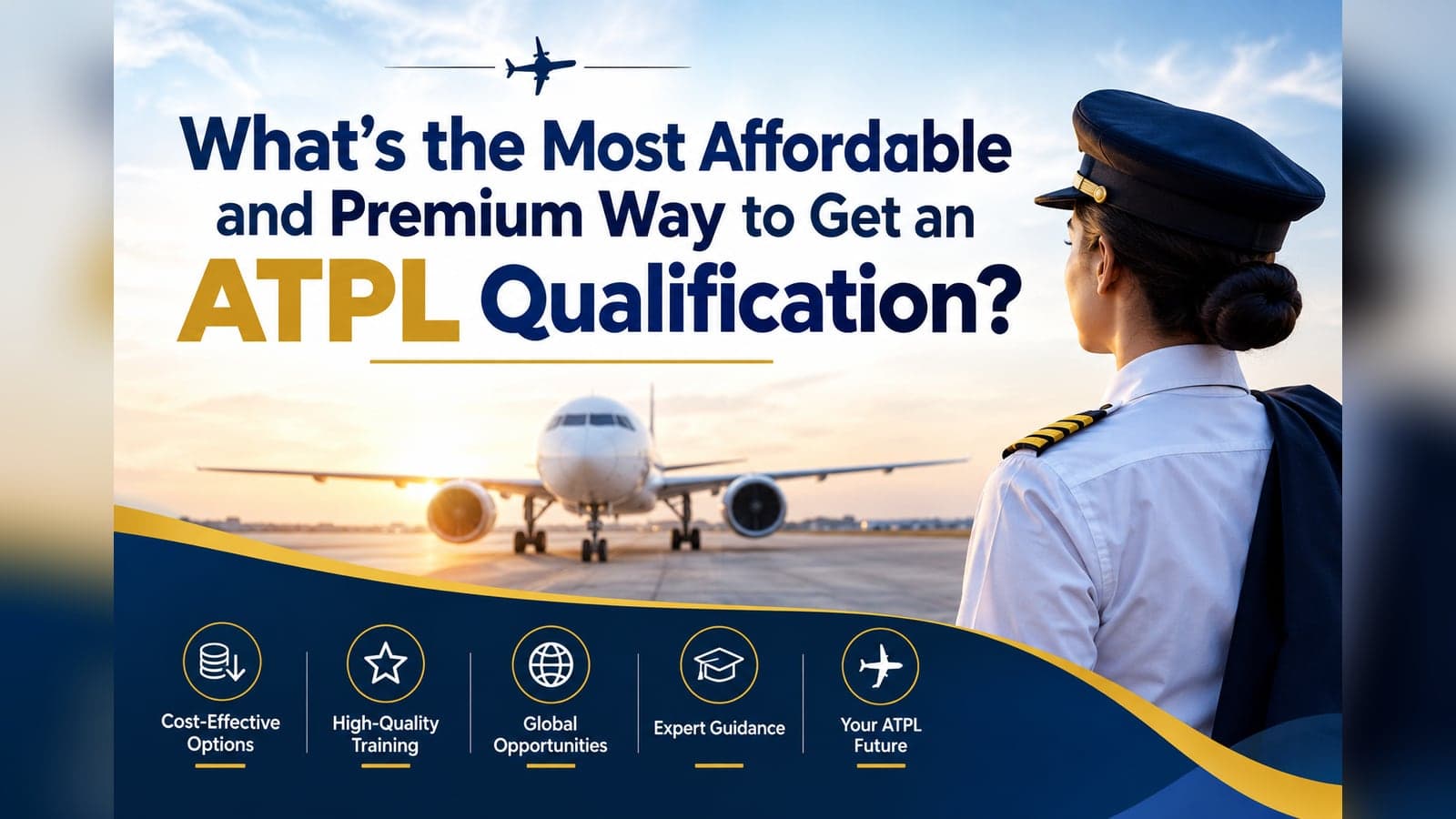
What's the Most Affordable and Premium Way to Get an ATPL Qualification?
You shouldn't have to choose between premium education and financial practicality. Remove unnecessary expenditure while protecting training quality.
Capt. Qaddar Sarfraz · 30 August 2026

Becoming an airline pilot is a significant investment. The cost is not limited to flight hours or the advertised price of a pilot-training programme. For many students, particularly those travelling internationally for training, the real cost includes theory training, examinations, study materials, accommodation, food, transportation, travel, additional training and potentially additional examination attempts.
So the better question is not “How can I find the lowest-priced ATPL course?” It is: “What is the most affordable way to receive premium training and reach my professional pilot goals without unnecessary expenditure?”
For aspiring pilots in Saudi Arabia, the GCC, Europe, the UK and other international markets, online theoretical knowledge preparation can be an important part of that strategy. This is where Airman's Ground offers a different approach: premium, expert-led ATPL and PPL theory and examination preparation delivered online, with personalised one-to-one instruction.
What is the most affordable and premium way to get an ATPL?
The most financially efficient pathway is rarely about choosing the lowest advertised course fee. Instead, it is about designing the entire training journey intelligently. For many students, this can involve:
- Choosing the right licence pathway
- Completing theoretical knowledge efficiently
- Studying online with expert instructors
- Preparing properly for examinations
- Avoiding unnecessary relocation during the theory phase
- Selecting an appropriate flight-training organisation
- Completing practical flight training where it makes financial and career sense
The result can be a training journey that combines premium education with controlled overall expenditure.
What makes ATPL training expensive?
When students research ATPL training, they often focus on tuition. But tuition is only one part of the total investment. Your overall cost may include:
- ATPL theoretical knowledge training and flight training
- Examination fees, study materials and question banks
- Accommodation, food and transportation
- International flights and visa-related costs
- Medical requirements
- Additional flight hours and additional training
- Examination re-sits and administrative costs
For an international student, these additional expenses can become substantial. This is particularly important for students from Saudi Arabia, the UAE, Qatar, Kuwait, Bahrain and Oman who may be considering training in Europe or the United Kingdom.
Is the lowest course fee really the most affordable option?
Not necessarily. Imagine two ATPL programmes. Programme A has a lower advertised tuition, but the student must relocate abroad, pay rent for several months, purchase additional study resources, arrange transportation, travel internationally and potentially spend longer preparing. Programme B involves a higher training investment, but the student receives one-to-one instruction, structured preparation, online delivery, instructor feedback, integrated study resources, examination preparation and greater flexibility.
The second programme may initially appear more expensive. But once the total cost of the journey is calculated, the result can be very different. That is why Airman's Ground focuses on value rather than simply price.
Why online ATPL theory can be more affordable
For many international students, the theoretical phase can take approximately 8–12 months, depending on the licensing pathway, training structure, examination schedule and individual progress. If a student relocates abroad for that entire period, they may be paying for much more than education: rent, food, transport, utilities, travel, insurance and daily living. Instead, an appropriate online theoretical knowledge arrangement can allow a student to study from their home country where permitted by their chosen regulatory pathway and training organisation.
The model becomes clear when you compare the two approaches. The traditional approach: move abroad → rent accommodation → ground school → exams → flight training. The online theory approach: stay at home → online expert instruction → examination preparation → exams → travel for flight training. The second approach can significantly reduce indirect costs for some international students.
How much can a student potentially save?
The exact amount depends entirely on the student's circumstances. However, when you combine overseas accommodation, food, transportation, international flights, visa-related expenses, additional travel, study materials and potential examination-related costs, the difference can become substantial. For some international students, the potential overall saving can approach USD 20,000 or EUR 20,000. This is not a guaranteed saving and should not be treated as a fixed discount. The actual amount depends on your country, training destination, city, accommodation, duration abroad, travel requirements, examination arrangements, training pathway and individual study progress.
If you can complete an appropriate part of your theoretical training from home, you may not need to pay overseas living costs for that entire period.
Can Saudi and GCC students study ATPL theory online?
For many students, this is one of the most attractive aspects of modern pilot training. A student living in Riyadh, Jeddah, Dammam, Dubai, Abu Dhabi, Doha, Kuwait City, Muscat or Manama may be able to complete appropriate theoretical training online, depending on the regulatory pathway and approved training arrangement. This means the student can potentially remain at home while completing theoretical knowledge preparation and then travel for the practical components of their training. For GCC students, this can provide:
- Financial flexibility — you remain in your existing living environment during the theory phase.
- Time flexibility — you can potentially study around university, employment or other commitments.
- Geographic flexibility — you are not necessarily tied to the location of your ground school.
- Access to expertise — you can learn from instructors regardless of where you physically live.
What about EASA ATPL training?
The EASA pathway is one of the most popular choices for students planning professional flight training in Europe. EASA's regulatory framework includes requirements for both integrated and modular training, with provisions relating to distance learning and computer-based training within applicable theoretical knowledge arrangements. However, students should not assume that every online ATPL course automatically satisfies every regulatory requirement. Your licence pathway, approved training organisation, theoretical knowledge requirements and examination arrangements must be aligned from the beginning. This is why professional guidance matters.
What about GCAA ATPL training?
For students targeting the United Arab Emirates and the wider GCC aviation market, the GCAA pathway may be relevant. GCAA has its own theoretical knowledge and examination requirements. Online learning can be particularly attractive to GCC-based students because it may reduce the need to relocate simply to complete ground-school preparation. However, students must confirm the current requirements and approved training arrangement applicable to their individual pathway.
What about UK CAA ATPL training?
The UK CAA has its own licensing and examination framework. Students planning to train or work through a UK CAA pathway should therefore structure their theoretical knowledge training around UK CAA requirements. Online preparation can provide flexibility, particularly for international students who do not want to spend the entire theory phase living in the United Kingdom. Again, the exact requirements should be confirmed before beginning training.
Should I choose integrated or modular ATPL training?
This depends on your circumstances.
Integrated ATPL
An integrated programme combines much of the training into a structured, continuous pathway. It can suit students who want a structured full-time programme, prefer one continuous training environment, and can commit financially and personally to the programme.
Modular ATPL
A modular pathway allows students to complete different stages separately. It can be particularly attractive to students who:
- Want greater flexibility
- Need to work while studying
- Want to control when they spend money
- Want to complete theory before relocating
- Want to select different training providers
- Prefer to spread the financial commitment
A modular pathway is not automatically more affordable. The way it is planned determines its financial efficiency.
Why expert mentorship matters
One of the biggest mistakes students make is believing that ATPL theory is simply a matter of buying books and completing a question bank. It isn't. ATPL theory covers complex subjects involving aircraft systems, meteorology, navigation, performance, flight planning, principles of flight, air law, human performance, radio navigation, instrumentation, communications and operational procedures. A student can read hundreds of pages and still misunderstand the underlying concept.
This is where an experienced instructor becomes valuable. A question bank can tell you: “Your answer is incorrect.” An instructor can explain: “This is why your answer is incorrect, where the concept comes from, and how you should approach this type of problem next time.” That difference can dramatically change the learning experience.
Books and notes cannot replace an expert mentor
Books are important. Study material is important. Question banks are important. But none of them can replace personalised instruction. A student can have multiple textbooks, notes, question banks and videos and still be unsure: What should I study first? Which material should I trust? Why am I getting this question wrong? Have I actually understood the subject? Am I ready for the examination?
At Airman's Ground, we believe the learning process should be study material → expert explanation → application → questions → feedback → revision, not book → memorisation → question bank → examination. The objective is to develop knowledge and examination readiness, not simply familiarity with questions.
Why Airman's Ground is a premium ATPL preparation platform
Airman's Ground is designed around expert-led aviation education rather than passive content consumption. Students receive a personalised learning experience through:
- One-to-one instructor-led classes — instead of sitting anonymously in a large classroom, students work directly with their instructor.
- Personalised scheduling — students can organise their studies around their individual commitments.
- EASA, GCAA and UK CAA preparation — training can be structured around the student's selected theoretical pathway.
- ATPL and PPL theory preparation — support from foundational pilot theory through professional-level theoretical knowledge preparation.
- Structured study material — students are guided toward relevant resources rather than being left to build a huge library of books and notes.
- Question-bank preparation — question banks are used as a preparation and assessment tool rather than as the entire learning method.
How does Airman's Ground's 14-day subject approach work?
At Airman's Ground, our preparation model aims to complete each individual subject within a maximum 14-day cycle, depending on the student's existing knowledge, availability and progress. This does not mean completing the entire ATPL in 14 days. It means approaching each subject through a focused learning cycle:
- Days 1–3: foundation — understand the fundamental concepts.
- Days 4–7: instructor-led learning — work systematically through the subject with an expert instructor.
- Days 8–10: application — apply the concepts and practise examination-style questions.
- Days 11–12: weakness identification — identify areas where the student requires further explanation or practice.
- Days 13–14: revision and readiness — consolidate the subject and assess examination readiness.
The student can then continue with targeted revision and examination preparation where required. The purpose is not to rush learning. The purpose is to prevent students from becoming indefinitely stuck on one subject.
How can faster, structured preparation reduce overall costs?
Time has a financial value. If your ATPL theory takes significantly longer than necessary, it can delay examinations, flight training, licence progression and employment plans. For students living abroad, delays can be particularly expensive: an additional month abroad means another month of accommodation, food, transport and daily expenses. Structured preparation can therefore contribute to financial efficiency. It does not guarantee a specific completion time or examination result, but it can provide students with a clear learning structure and accountability.
Is self-study more affordable than instructor-led ATPL training?
Self-study can certainly have a lower upfront cost. But lower upfront cost does not always mean lower overall cost. Consider the hidden costs of learning alone. You might:
- Buy several books and subscribe to multiple question banks
- Watch countless videos and search online forums
- Repeat difficult chapters and spend weeks on one subject
- Take an examination before you are ready
- Need additional preparation afterward
Your time is also an investment. A premium instructor-led programme costs more than simply buying a book because you are paying for expertise, structure, feedback and personalised support. The question is therefore not “How much does the course cost?” It is: “What value does the training provide relative to the total cost of my pilot journey?”
What about ATPL examination attempts?
Examination preparation is one of the most important parts of the training journey. An additional attempt may involve more than the examination fee. For an international student, it could mean additional preparation, another examination fee, another flight, accommodation, transportation and time away from work or studies. This is why proper preparation matters. No responsible training provider can guarantee that every student will pass every examination on the first attempt. But premium instruction can help identify weaknesses before the examination and improve the student's readiness.
Can Airman's Ground help international students save money?
Yes—but the saving should be understood as cost optimisation rather than a guaranteed discount. Airman's Ground's online model can potentially help students reduce costs associated with:
- Relocating for ground school
- Overseas accommodation and daily living expenses
- Local transportation and repeated travel
- Duplicate study materials
- Inefficient preparation
For international students, these expenses can represent a substantial part of the overall pilot-training budget. The money saved can potentially be redirected toward the stages of training that require physical presence—such as flight training.
Where can I complete my flight training?
Your practical training destination depends on your licence and career pathway. Students may consider approved flight-training options in Europe (particularly relevant to students pursuing an EASA pathway), the United Kingdom (relevant to students pursuing a UK CAA pathway) and the United Arab Emirates (particularly relevant to students considering the GCAA pathway and the broader Middle Eastern aviation market). The key is to decide your regulatory and career pathway before spending heavily on training.
What should Saudi and GCC students consider?
If you are based in Saudi Arabia or the GCC, ask yourself:
- Do I really need to relocate for the entire theory phase? If your approved pathway allows appropriate online learning, potentially not.
- Can I study around my current job? One-to-one online training can make this possible for many students.
- Where do I ultimately want to fly? Your target market should influence your licensing pathway.
- What is the total cost? Don't calculate tuition alone.
- Who will mentor me? Don't underestimate the value of expert guidance.
- What study material will I use? Avoid buying unnecessary resources.
- How will I prepare for examinations? A structured examination strategy is essential.
What is the most affordable ATPL strategy for a GCC student?
A potentially efficient model is: Saudi Arabia/GCC → online EASA, GCAA or UK CAA theoretical knowledge preparation → expert-led examination preparation → required examinations → Europe/UK/UAE → flight training. This approach allows the student to spend less time abroad before the practical phase begins. And fewer months abroad can mean lower accommodation costs, food costs, transportation costs, travel costs and living expenses.
What should you look for in an affordable premium ATPL provider?
Don't select your training provider based solely on price. Look for:
- Expert instructors — do the instructors actually understand the subjects they teach?
- One-to-one support — can your weaknesses be addressed individually?
- Regulatory alignment — does the training fit your chosen licensing pathway?
- Structured learning — is there a clear plan for progressing through the subjects?
- Quality study material — are students guided toward appropriate resources?
- Examination preparation — does the provider prepare you to understand and apply the knowledge?
- Flexibility — can you study around work, university or other commitments?
- Transparent costs — do you understand what is included and what isn't?
Why “affordable” and “premium” should go together
There is a common misconception that premium means expensive and affordable means lower quality. That isn't necessarily true. A premium training model can become more affordable when it eliminates unnecessary costs. For example: premium one-to-one online instruction, no need to relocate solely for ground school, structured preparation, focused subject cycles and relevant study materials add up to one thing.
Premium education with greater financial efficiency. This is the model Airman's Ground aims to provide.
The Airman's Ground difference
Airman's Ground was created with a simple philosophy: pilots should not have to navigate complex aviation theory alone. Whether you are preparing for PPL, EASA ATPL, GCAA ATPL or UK CAA ATPL, the objective is the same: understand the knowledge, build competence, prepare properly, progress with confidence. Our online platform allows students to access personalised instructor-led training without automatically relocating for ground school. And because the training is one-to-one, the instructor can focus on the student's actual needs rather than teaching an entire classroom at one pace.
Is Airman's Ground suitable for students in Europe and the Middle East?
Yes. The online model is particularly suitable for international students who want access to expert aviation theory preparation regardless of where they live. This includes aspiring pilots in Saudi Arabia, the UAE, Qatar, Kuwait, Bahrain, Oman, the United Kingdom, Germany, France, Greece, Spain, Italy, other European countries, Asia and Africa. The student's physical location does not have to determine the quality of their theoretical education.
The most affordable ATPL is not always the lowest-priced ATPL
This is the most important lesson. A lower course fee can be attractive. But if the student then spends thousands on accommodation, travel, food, additional study materials, delayed training and examination attempts, the apparent saving can disappear. The smarter strategy is to look at the complete cost of reaching the cockpit.
Final verdict: what's the most affordable and premium way to get an ATPL?
The most affordable and premium ATPL pathway is not about cutting corners. It is about removing unnecessary expenditure while protecting training quality. For many students, especially those in Saudi Arabia, the GCC, Europe and other international markets, that can mean:
- Choosing the correct EASA, GCAA or UK CAA pathway
- Considering modular training where appropriate
- Completing theoretical knowledge preparation online where permitted
- Learning with expert instructors
- Using structured study material
- Preparing properly for examinations
- Avoiding unnecessary relocation during the theory phase
- Selecting flight training based on quality, regulatory suitability and total value
- Planning the complete financial journey before starting
This is the philosophy behind Airman's Ground. We don't believe aspiring pilots should have to choose between premium education and financial practicality. Our aim is to provide a premium, personalised learning experience for ATPL and PPL theory and examination preparation, while helping students avoid unnecessary expenses associated with traditional ground-school arrangements.
For an international student, that can potentially mean saving tens of thousands of dollars or euros that would otherwise be spent on overseas living and related expenses. And those savings can remain available for what comes next: flight training. Because becoming an airline pilot is already a major investment. Your money should be spent on training that moves you forward—not expenses that simply keep you abroad.
Frequently asked questions
What is the most affordable way to get an ATPL?
A carefully planned modular pathway combined with appropriate online theoretical knowledge preparation can be financially efficient for many students. The best pathway depends on your licensing authority, training organisation, location and career goals.
Is premium ATPL training worth the investment?
Premium training can be valuable when it provides experienced instructors, personalised support, structured preparation, quality resources and effective examination preparation. The goal is to evaluate the total value, not simply the course price.
Can I study ATPL theory online?
Online theoretical knowledge training may be available depending on the requirements of your chosen regulator and approved training arrangement. Students should confirm the exact requirements before enrolling.
Can I study EASA ATPL online?
Appropriate distance-learning and computer-based training arrangements can form part of applicable EASA theoretical knowledge training. The specific requirements must be confirmed with the relevant approved training organisation.
Can I study GCAA ATPL online?
Online learning can be incorporated into applicable GCAA training arrangements, subject to the relevant regulatory and approved-training requirements.
Can I study UK CAA ATPL online?
Online or distance-learning options may be available depending on the UK CAA pathway and approved training arrangement.
How long does ATPL theory take?
A realistic planning timeframe for many students is approximately 8–12 months, although this varies according to the licence pathway, study schedule, examination requirements and individual progress.
How much can I save by studying ATPL theory online?
There is no fixed saving. However, international students who avoid several months of overseas accommodation, food, transportation and travel may potentially save a substantial amount. In some circumstances, the difference can approach USD 20,000 or EUR 20,000.
Can I study ATPL theory from Saudi Arabia?
Depending on your chosen licence pathway and approved training arrangement, online theoretical preparation can allow many students to study from Saudi Arabia without relocating solely for ground school.
Can GCC students study ATPL theory online?
Yes, online learning can be a highly practical option for students in Saudi Arabia, UAE, Qatar, Kuwait, Bahrain and Oman, subject to the requirements of their selected regulatory pathway.
Can I study theory online and complete flight training in Europe?
Potentially, depending on your licensing pathway and the approved training organisations involved.
Can I study theory online and fly in the UK?
Potentially, subject to the applicable UK CAA requirements and training arrangements.
Can I study theory online and complete flight training in the UAE?
Potentially, depending on your GCAA pathway and the approved training organisation you select.
Is self-study the most affordable ATPL option?
Not necessarily. Self-study may have a lower initial cost, but additional study materials, lost time, inefficient preparation and examination attempts can increase the overall cost.
Can Airman's Ground help with PPL theory?
Yes. Airman's Ground provides PPL as well as ATPL theory and examination preparation, using an expert-led online learning model.
Can Airman's Ground guarantee an ATPL pass?
No responsible training provider should guarantee examination results. Airman's Ground focuses on structured preparation, expert instruction, identifying weaknesses and helping students become properly prepared for their examinations.
Why choose Airman's Ground?
Because the focus is not simply on giving students books and question banks. Airman's Ground combines premium one-to-one instruction, structured preparation, study resources and examination preparation in an online environment designed for modern international pilot students.
Airman's Ground
Premium aviation education. Affordable access. Expert mentorship. EASA | GCAA | UK CAA. ATPL theory and examination preparation. PPL theory and examination preparation. Online. One-to-one. Personalised. Wherever you are, your pilot journey can begin.