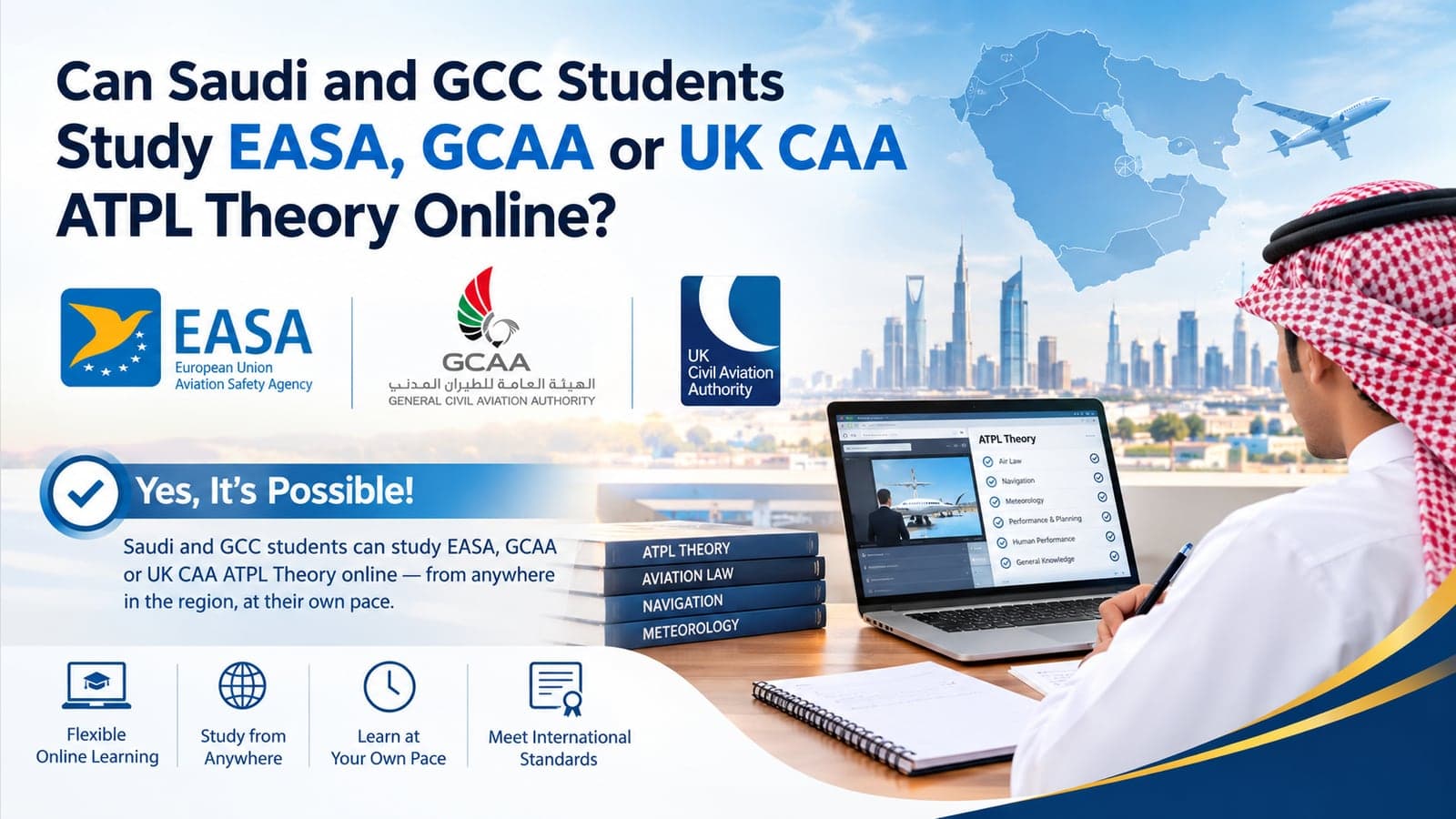
Can Saudi and GCC Students Study EASA, GCAA or UK CAA ATPL Theory Online?
Study at home. Fly where the training takes you.
Capt. Qaddar Sarfraz · 22 August 2026

Yes. For many aspiring pilots in Saudi Arabia and the GCC, studying ATPL theory online can be a far more practical and cost-efficient approach than relocating to Europe or the UK for months of classroom-based ground school. The key is understanding what can be done online and what still requires physical attendance. Your theoretical knowledge and exam preparation can be structured around online learning, while the practical flight training takes place at the appropriate approved training organisation.
That means a student living in Saudi Arabia, the United Arab Emirates, Qatar, Kuwait, Bahrain, Oman or another GCC country does not necessarily need to relocate abroad simply to study ATPL theory. Instead, the student can study from home with experienced instructors and then travel when physical training or examination requirements make it necessary. For many students, this can mean a major difference in the overall cost and convenience of becoming a professional pilot.
Why is this important for Saudi and GCC students?
Becoming an airline pilot is already a significant financial investment. For an international student, however, the cost isn't limited to tuition. There are two very different types of expenditure.
Direct training costs
- Ground-school fees
- Flight training
- Examination fees
- Study materials
- Simulator training
- Licence-related costs
Indirect costs
- International flights
- Accommodation, food and local transportation
- Visa expenses and insurance
- Utilities and living expenses
- Time away from employment or family
The second category is often overlooked when students compare pilot-training programmes. A course may appear affordable until the student calculates the cost of living abroad for several months. This is particularly relevant for students from Saudi Arabia and the wider GCC who may be considering flight training in Europe or the UK.
Do I have to move to Europe to study EASA ATPL theory?
Not necessarily. This is one of the biggest misconceptions among international students. Studying for an EASA ATPL does not automatically mean that you need to live in Europe throughout your theoretical knowledge preparation. The exact requirements depend on your licensing route, training organisation and applicable EASA rules, so students should confirm their individual pathway before enrolling. But from a practical perspective, online theoretical knowledge preparation allows students to access instruction without necessarily relocating for the entire theory phase.
That creates an attractive model: Saudi Arabia/GCC → online ATPL theory → examinations → Europe/UK/UAE → flight training. Instead of: Saudi Arabia/GCC → relocate to Europe → accommodation → ground school → examinations → return or move again → flight training. The first model can significantly reduce unnecessary relocation costs.
Can GCC students study GCAA ATPL theory online?
Online learning can be incorporated into GCAA theoretical knowledge training, subject to the applicable requirements and approved training arrangement. The UAE General Civil Aviation Authority's framework recognises computer-based training and e-learning elements within theoretical knowledge instruction. For a student living in the GCC, this can make online preparation particularly convenient: you can potentially remain in your home country while completing structured theoretical training and preparing for your examinations, rather than relocating simply to sit inside a classroom. However, always confirm the exact GCAA requirements applicable to your licence and training route before beginning your programme.
What about UK CAA ATPL theory?
The UK CAA has its own regulatory and examination framework. Students following a UK CAA pathway should therefore plan their theory, examinations and flight training around UK CAA requirements rather than assuming that the EASA or GCAA process is identical. The advantage of online preparation remains the same: you can potentially complete much of the learning from the GCC and travel to the UK when required for examinations or practical training. That can make the UK pathway much more manageable for an international student.
How long does ATPL theory take?
A realistic planning period for many students is approximately 8–12 months, although the actual duration depends on:
- Your licensing authority and integrated or modular pathway
- Previous qualifications and the number of subjects
- Study hours and examination schedule
- Learning pace and instructor support
- Individual academic performance
There is no universal “ATPL takes exactly X months” answer. A full-time student can progress differently from someone working in Riyadh. A student studying every day can progress differently from someone studying around university. And a student receiving structured one-to-one mentoring can have a very different experience from someone attempting to navigate the syllabus alone.
Can I study ATPL while living and working in Saudi Arabia?
Yes, this is one of the strongest use cases for online ATPL preparation. Imagine you are working in Riyadh, Jeddah, Dammam, Dhahran or another Saudi city. You have a full-time job. You want to become an airline pilot. But you cannot simply resign and move to Europe for eight or twelve months. Online theory preparation gives you another option: you can structure your study around your working life. For example:
- Weekdays — 1–2 hours of focused study or instructor sessions.
- Weekends — longer study and revision sessions.
- Throughout the programme — progress monitoring, question practice and targeted revision.
Then, when the theory phase is complete, you can move into the practical flying stage. This is particularly attractive to career changers and professionals who need to maintain their income while preparing for aviation.
How much money can an online ATPL student save?
This is where the financial argument becomes particularly interesting. Airman's Ground believes that an online theory model can potentially help international students save around USD 20,000 or EUR 20,000 in certain circumstances, primarily by reducing expenses associated with relocating abroad for theoretical training. However, this should be treated as a potential saving, not a guaranteed amount for every student. Your actual saving depends on where you would otherwise live, how long you would stay abroad, accommodation costs, food expenses, transportation, flights, visa costs, exchange rates, the number of examination trips, whether you require additional attempts, and study-material expenditure.
For some students, the saving could be less. For others, it could potentially be greater. The important point is that online training can remove a significant category of expenditure before flight training even begins.
Where does the $20,000 saving come from?
It isn't necessarily one single discount. It can come from avoiding several smaller expenses that accumulate over 8–12 months. For example:
- Accommodation — renting a room or apartment abroad for several months.
- Food — daily meals and household expenses.
- Transportation — public transport, taxis, fuel and other local travel.
- International travel — flights to and from Europe or the UK.
- Visa and administrative expenses, where applicable.
- Additional examination travel — travelling internationally for examinations can add up.
- Additional examination attempts — an unsuccessful attempt can mean more than just another examination fee; it may mean additional preparation, travel and accommodation.
- Study materials — students can also spend unnecessarily on multiple books, notes and subscriptions.
When all these costs are considered together, the financial advantage of remaining at home during the theory phase can become significant.
What about failed ATPL exams?
This is an important part of the financial calculation. Students often calculate: course fee + examination fee = ATPL cost. But the actual calculation should be: training + examinations + travel + accommodation + living costs + time + potential additional attempts. A failed examination may therefore cost much more than the examination fee itself. For an international student, another attempt can potentially mean more preparation, another examination, another flight, accommodation and time. This is why quality preparation matters. The objective should not simply be to get a student into an examination quickly. It should be to help the student enter when they are properly prepared.
Can expert mentoring help reduce unnecessary attempts?
It can help reduce avoidable preparation mistakes. No training provider can responsibly guarantee that a student will never fail an examination—every student is different. However, structured mentoring can identify weaknesses before the examination. An instructor can see:
- Which concepts you repeatedly misunderstand
- Which questions you consistently get wrong
- Whether you are memorising instead of understanding
- Where calculations are going wrong
- Which subjects require additional revision
- Whether you are genuinely ready for the examination
A question bank can tell you that your answer is wrong. An instructor can help you understand why.
Are books and notes enough for ATPL?
Books are essential. But books alone are not a complete learning strategy. This distinction is particularly important for students studying remotely. ATPL students have access to enormous amounts of information: textbooks, notes, question banks, videos, apps, online forums, practice examinations and AI tools. The problem is often not lack of information—it is too much information without direction. A student can spend hours deciding which book to use, which notes are correct, which questions to practise, why one answer differs from what they read, and whether they are actually ready. That is where an expert instructor becomes valuable.
What does Airman's Ground do differently?
Airman's Ground was built around a simple idea: students should not have to navigate aviation theory alone. Our approach combines an expert instructor, one-to-one learning, a structured study plan, study material, question practice and progress monitoring—rather than simply giving a student access to a library of material. Our instructors work with students individually, allowing the learning process to adapt to their background, pace, availability, strengths, weaknesses and examination goals. For a student sitting in Saudi Arabia or another GCC country, this means direct access to instructor-led preparation without the need to relocate for ordinary classroom attendance.
How does the 14-day subject approach work?
At Airman's Ground, our preparation model aims to complete each individual subject within a maximum 14-day cycle, where the student's circumstances and progress make this appropriate. This does not mean that the entire ATPL is completed in 14 days. It means that each subject is given a focused and structured preparation period. For example:
- Days 1–3 — concept introduction and foundation.
- Days 4–7 — detailed instructor-led learning.
- Days 8–10 — application and question practice.
- Days 11–12 — weakness identification and correction.
- Days 13–14 — revision and readiness assessment.
The student then continues with the wider examination preparation and revision process. This structure prevents one of the most common problems in ATPL training: getting stuck on one subject for months.
Why is this particularly valuable for GCC students?
Because distance can be expensive. A student living in Saudi Arabia does not necessarily need to spend eight months paying European rent simply to study theoretical knowledge. A student in Qatar does not necessarily need to relocate to the UK simply to sit in a classroom. A student in Kuwait does not necessarily need to move abroad before they are ready for the flying phase.
The GCC is already one of the world's most important aviation markets. Students are looking toward airlines such as Emirates, Qatar Airways, Etihad Airways, flydubai, Saudia, Riyadh Air, Air Arabia, Gulf Air, Oman Air and Kuwait Airways. For aspiring pilots, the ultimate goal is not simply passing an ATPL examination. It is building the knowledge, skills and professional standards required to progress toward an airline cockpit.
Should GCC students choose EASA, GCAA or UK CAA?
This depends on your career and training plan. There is no single licence that is automatically best for every student. Your decision should consider:
- Where you intend to complete flight training
- Where you expect to work
- Which licence your target employers require or accept
- Conversion requirements and training availability
- Cost and examination arrangements
- Long-term career plans
A student targeting the UAE may investigate the GCAA pathway. A student planning European flight training may consider the EASA route. A student specifically targeting UK licensing may pursue the UK CAA pathway. The important thing is to make this decision before investing heavily in training.
Can I study theory in Saudi Arabia and fly in Europe?
Potentially, depending on your chosen licensing pathway and the approvals of the training organisations involved. This is one of the most attractive aspects of a modular approach: you can potentially separate the theory phase from the flight-training phase. For example, in Saudi Arabia you complete online theoretical knowledge preparation, examination preparation and the required examinations; in Europe you complete practical flight training, CPL/IR/ME and applicable training, and further professional qualifications. This allows you to select a flight-training destination based on the quality and suitability of its flying environment rather than simply choosing a school because it offers classroom theory.
Can I study theory in Saudi Arabia and fly in the UK?
Again, potentially yes, subject to the applicable UK CAA pathway and training requirements. The UK remains an important pilot-training destination, but living costs can be substantial. For an international student, reducing the amount of time spent abroad can therefore be financially attractive. Instead of spending the entire theory phase in the UK, a student may be able to structure the theoretical learning remotely and reserve the UK stay for the training and examination elements that require physical presence.
Can I study theory in Saudi Arabia and fly in the UAE?
For students pursuing an appropriate GCAA pathway, the UAE offers an attractive option for practical aviation training. The UAE is also home to a major airline ecosystem, which makes it particularly interesting to GCC students aspiring to careers in Middle Eastern aviation. Again, however, the licence, training organisation and regulatory requirements must be aligned from the beginning.
What is the smartest way to plan pilot training?
Don't begin with “which flight school is the lowest priced?” Begin with “what licence do I need, where do I want to work, and what is the most efficient training pathway to get there?” Then calculate the total cost. That should include theory, exams, study material, flight training, accommodation, travel, living expenses and possible additional attempts. This is the number that matters.
Why Airman's Ground can be a financially smart starting point
For a Saudi or GCC student, the value of Airman's Ground is not simply the price of the course. It is the cost you may avoid. By completing theory online, you may be able to avoid:
- Months of overseas accommodation
- Daily living expenses and local transportation
- Unnecessary international travel
- Duplicate study materials
- Some costs associated with additional examination attempts
Depending on individual circumstances, these savings can potentially approach USD 20,000 or EUR 20,000. That money can instead remain available for the part of your training that actually requires you to be there: flight training.
What should a Saudi or GCC student do before enrolling?
Ask these questions:
- Which licence am I pursuing? EASA, GCAA or UK CAA?
- Where do I ultimately want to fly? Europe, UK, UAE or another market?
- Which flight-training organisation will I use? Identify this before building your complete pathway.
- Where will I take my examinations? Confirm the applicable examination arrangements.
- How will I study? Self-study, classroom, recorded lessons or one-to-one mentoring?
- What study material is included? Don't buy the same material multiple times.
- What happens if I struggle? Make sure there is real instructor support.
- What is my total budget? Include living and travel costs—not just tuition.
The biggest mistake GCC students can make
The biggest mistake is assuming that the most expensive training pathway must be the best. It isn't. Nor is the lowest-priced automatically the smartest. The smartest pathway is the one that balances quality, regulatory compliance, training efficiency, career suitability and total cost. For an international student, relocating abroad for every stage of training can create unnecessary costs. A smarter strategy may be to complete the theoretical component from home and travel when physical training is actually required.
Final answer: should Saudi and GCC students study ATPL theory online?
For many students, yes. If your goal is to pursue an EASA, GCAA or UK CAA pathway, online theoretical knowledge preparation can offer significant flexibility. You can potentially spend the 8–12 month theory phase studying from Saudi Arabia or another GCC country while maintaining your normal lifestyle, work or education. Then you can travel to Europe, the UK or UAE for the practical flight-training phase appropriate to your licensing pathway.
And this is where Airman's Ground offers a particularly compelling model. Instead of spending months abroad paying for accommodation, food, transportation and other living expenses before you even begin flying, you can access personalised online instruction from where you already live. Our one-to-one approach also means you are not simply handed a pile of books and question banks and told to figure everything out yourself—your instructor guides you through the learning process. Our subject preparation model aims for a maximum 14-day cycle per subject, helping students maintain momentum and avoid spending months trapped in one area.
And when the total economics are considered, online theory can potentially save an international student around USD 20,000 or EUR 20,000, depending on their circumstances and the costs they would otherwise incur. That isn't just a saving. It can mean having more of your budget available for the most important part of becoming a pilot: learning to fly.
Frequently asked questions for Saudi & GCC students
Can I study EASA ATPL from Saudi Arabia?
Online theoretical knowledge preparation may allow students to study from Saudi Arabia, subject to the applicable EASA training and examination requirements and the approved training arrangement.
Can I study GCAA ATPL from Saudi Arabia?
GCAA theoretical knowledge training can incorporate computer-based and e-learning elements, subject to the applicable requirements. Students should confirm the exact pathway with their approved training organisation.
Can I study UK CAA ATPL from Saudi Arabia?
Online or distance-learning arrangements may be available within the applicable UK CAA modular pathway. Examination and licensing requirements should be confirmed before beginning training.
How long does ATPL theory take?
Many students plan approximately 8–12 months, but the actual duration varies according to the regulatory pathway, study schedule, previous qualifications, examination schedule and individual progress.
Can I study ATPL theory online and fly in Europe?
Potentially, depending on the licence and approved training pathway you select.
Can I study ATPL theory online and fly in the UK?
Potentially, subject to UK CAA requirements and the training organisation you select.
Can I study ATPL theory online and fly in the UAE?
Potentially, subject to the relevant GCAA pathway and approved training arrangements.
How much can I save by studying ATPL online?
The saving varies by student. Avoiding several months of overseas accommodation, food, transportation and travel can create substantial savings. In some circumstances, the overall difference may approach USD 20,000 or EUR 20,000, but this is not a guaranteed saving.
Does Airman's Ground provide ATPL study material?
Airman's Ground incorporates structured study resources into its training approach, helping students avoid the confusion and unnecessary expense of collecting multiple sources independently.
Can Airman's Ground guarantee that I will pass my ATPL exams?
No responsible training provider should guarantee examination results. The purpose of structured mentoring is to improve preparation, identify weaknesses and help students approach examinations when they are genuinely ready.
Why should I choose one-to-one ATPL mentoring?
Because aviation theory is complex and students do not all struggle with the same concepts. One-to-one mentoring allows the instructor to adapt explanations, identify individual weaknesses and provide immediate feedback.
Your cockpit journey doesn't have to begin with relocation
For a young pilot in Saudi Arabia or the GCC, the dream may be thousands of kilometres away: Europe. The United Kingdom. The UAE. But your preparation doesn't have to be. You can begin where you are. You can learn from experienced instructors. You can build your theoretical knowledge online. You can prepare systematically for your examinations. And when the time comes to fly, you can travel to the training environment that best fits your licensing and career plan.
Study at home. Fly where the training takes you.
That is the advantage of making pilot training more flexible. And that is the philosophy behind Airman's Ground.