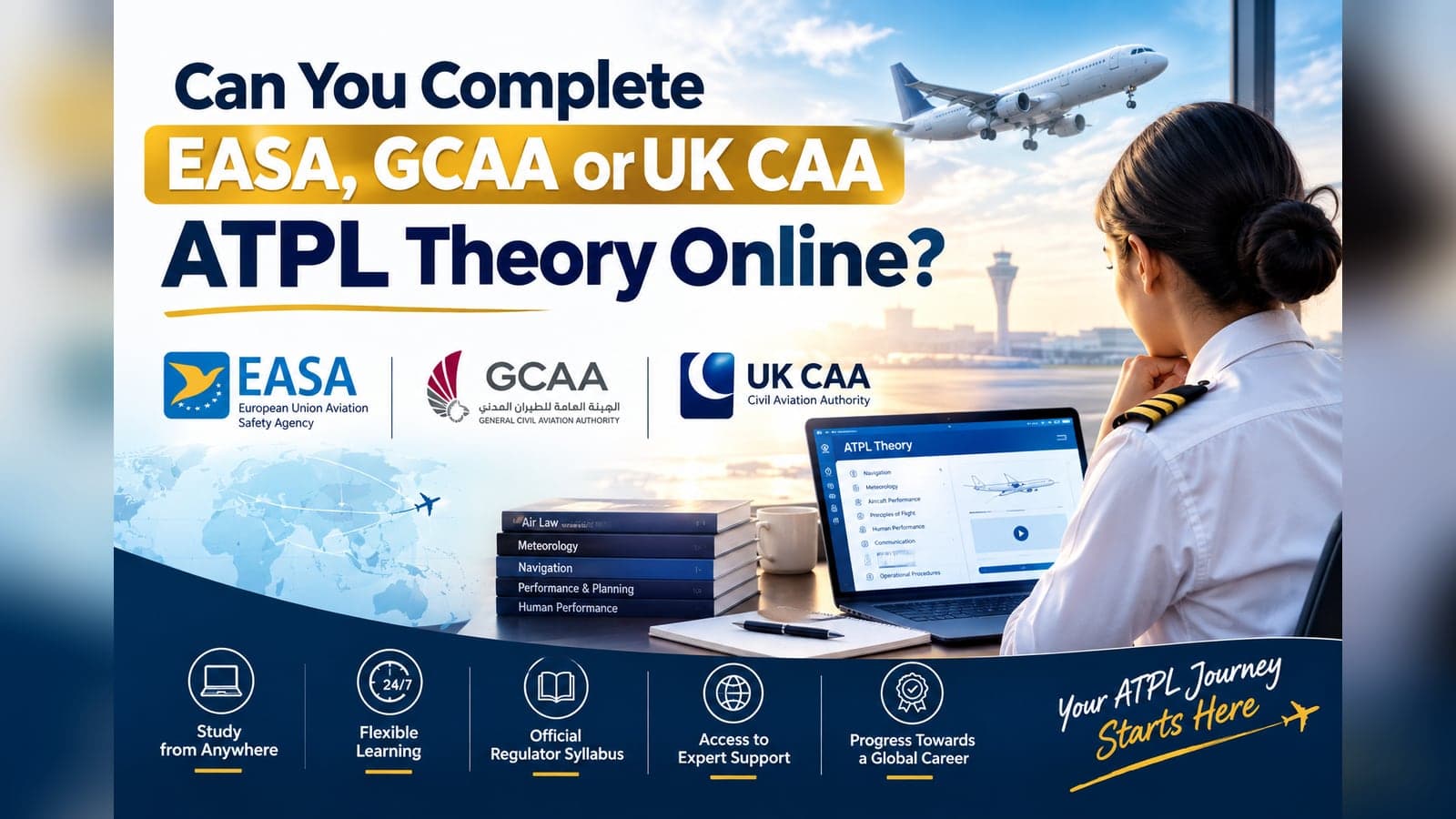
Can You Complete EASA, GCAA or UK CAA ATPL Theory Online?
Study your ATPL theory online, complete your examinations, then travel for flight training when required.
Capt. Qaddar Sarfraz · 15 August 2026

Yes. And for many aspiring airline pilots, online theoretical knowledge training can be one of the most practical ways to complete the ground-school phase of their pilot training. But there is an important distinction: online ATPL theory does not mean online flight training. The theoretical knowledge component can be studied remotely through an appropriately structured programme, while the practical flight training is completed physically at an approved training organisation in the relevant jurisdiction.
This creates an increasingly attractive model for international students: study your ATPL theory online, complete your examinations, then travel for flight training when required. For a student based in the Middle East, Asia or another part of the world, this can eliminate a significant amount of unnecessary travel and living expenditure during the theory phase.
At Airman's Ground, we have built our online training model around exactly this problem. Instead of asking a student to relocate simply to sit in a classroom and study theoretical subjects, we bring the classroom to the student through one-to-one, instructor-led online training. And when planned properly, the savings can be substantial.
How long does ATPL theory usually take?
A realistic planning window for many students is approximately 8–12 months, depending on the licensing authority, training route, examination schedule, previous qualifications, study availability and individual progress. This should not be confused with the total time required to become an airline pilot. The complete pilot-training journey involves much more than theoretical knowledge. It may include:
- PPL or equivalent training
- ATPL theoretical knowledge
- CPL, Instrument Rating and Multi-Engine training
- Multi-Crew Cooperation and UPRT where applicable
- Flight experience and skill tests
- Medical certification
- Type rating or airline-specific training
- Airline selection and assessment
The theory component is therefore one part of the larger journey. For many students, however, it is one of the most demanding academic phases. EASA's ATPL framework includes 13 theoretical knowledge subject areas, including Air Law, Aircraft General Knowledge, Mass and Balance, Performance, Flight Planning and Monitoring, Human Performance, Meteorology, General Navigation, Radio Navigation, Operational Procedures, Principles of Flight and Communications. The GCAA ATPL framework similarly contains a comprehensive theoretical knowledge syllabus and specifies substantial training requirements for integrated programmes. GCAA documentation also explicitly recognises computer-based training and e-learning as possible components of theoretical knowledge instruction.
Does studying ATPL online mean you can avoid flight school?
No. This is one of the most important points for aspiring pilots to understand. Online ATPL theory is a ground-school solution, not a replacement for practical flight training. You still need to complete the applicable practical training requirements at an appropriately approved training organisation. The advantage is that you do not necessarily need to spend the entire theoretical phase living near your flight school. This creates a more flexible training strategy:
- Phase 1 — complete theoretical knowledge online.
- Phase 2 — complete the required examinations.
- Phase 3 — travel to your chosen flight-training destination.
- Phase 4 — complete practical flight training in Europe, the UK or UAE, depending on your licensing pathway and chosen organisation.
This separation can make a significant difference to the overall cost of pilot training.
Why would a student study ATPL theory online?
The obvious answer is flexibility. But flexibility is only one benefit—the bigger advantage is cost efficiency. Imagine a student from Saudi Arabia, the UAE, Qatar, Pakistan, India, Morocco or another international market travelling to Europe for several months purely to attend ground school. The student may have to pay for accommodation, food, local transportation, visa expenses, flights, insurance, utilities, classroom-related expenses and additional living costs. And those expenses continue whether the student is actually learning efficiently or not.
With online theoretical knowledge training, the student can remain at home—or wherever they are already based—and access the instructor remotely. That means the money is spent on training rather than relocation.
Can online ATPL training really save $20,000 or €20,000?
It can potentially create savings of this magnitude, but the exact amount depends entirely on the student's circumstances. It would be misleading to promise every student a fixed $20,000 or €20,000 saving. However, when accommodation, food, transportation, international travel and other living expenses are removed from several months of theory training, the total difference can become substantial. For an international student spending 8–12 months abroad, the cumulative cost of living can easily become one of the largest parts of the training budget.
Consider the difference between the traditional model—relocate, rent accommodation, pay living expenses, attend classroom, return home, travel again for practical training—and the online theory model: stay at home, study with instructors online, complete theory preparation, then travel for practical flight training. The second model allows the student to reserve international travel and accommodation costs for the part of training that genuinely requires physical presence: flying. That is where online ATPL preparation becomes financially strategic rather than simply convenient.
What about study material?
This is another area where students often spend unnecessarily. An aspiring pilot can easily accumulate multiple textbooks, different sets of notes, question banks, printed materials, revision guides, online subscriptions, apps, videos and practice examinations. The problem is not that these resources are bad—the problem is that students often don't know which resources they actually need or how to use them effectively.
At Airman's Ground, study material is integrated into the learning process rather than leaving students to build their own library. The objective is simple: you should spend your time learning aviation—not searching the internet for what to study next.
Why books alone are not enough
This is perhaps the biggest difference between buying an online course and receiving professional mentoring. A book can explain a concept. A question bank can test it. But neither can look at you and say: “You understand the formula, but you don't understand when to apply it.” That is the role of an instructor.
ATPL is not simply a memory exercise. A professional pilot needs to understand relationships between systems, weather, performance, navigation, operational procedures and human performance. That is why expert mentoring matters. At Airman's Ground, the objective is not simply to get students through pages of material—it is to help them understand the material well enough to apply it.
How does Airman's Ground complete a subject in 14 days?
One of the distinguishing features of our training approach is the use of an intensive subject cycle. Our target is to complete the instructor-led preparation of each subject within a maximum of 14 days, depending on the student's availability, background and demonstrated progress. This does not mean that a student magically masters an entire subject forever in 14 days—it means the subject has a structured preparation window. A typical cycle includes:
- Days 1–3: concept building — the instructor introduces the major principles and establishes the conceptual framework.
- Days 4–7: guided learning — the student works through important areas with the instructor and asks questions in real time.
- Days 8–10: application — the student begins applying the knowledge through exercises and examination-style questions.
- Days 11–12: weakness identification — incorrect answers and difficult concepts are analysed.
- Days 13–14: consolidation — the student revises, practises and assesses readiness.
This approach creates something that self-study often lacks: momentum.
Why does one-to-one training matter?
Imagine two students preparing for the same ATPL examination. Both have the same textbook and access to the same question bank. But Student A studies alone, while Student B has an instructor. When Student A gets a question wrong, they may simply look at the correct answer. Student B can ask: “Why is this the correct answer?” That conversation can reveal a misunderstanding that would otherwise remain hidden. This is the value of personalised training. The instructor can identify:
- Knowledge gaps and repeated mistakes
- Weak subjects and calculation errors
- Misinterpretations and poor study habits
- Examination anxiety
- Areas requiring additional revision
For an international student studying remotely, this level of interaction can make online education feel less like studying alone and more like having a personal aviation mentor.
Can you study EASA ATPL online?
Yes, subject to the applicable training and approval requirements. EASA's ATPL framework requires applicants to complete the relevant training course at an ATO, through either an integrated or modular route. Therefore, students should always verify that their chosen online arrangement satisfies the applicable regulatory requirements for their specific licence and training route. The important distinction is between self-study from home and structured theoretical knowledge training delivered online through an appropriate training organisation. They are not necessarily the same thing.
Can you study GCAA ATPL online?
Online learning can form part of GCAA theoretical knowledge training. The GCAA's regulations specifically recognise computer-based training and e-learning elements as possible components of theoretical knowledge instruction. GCAA documentation also specifies extensive theoretical knowledge requirements for ATPL training and lists the relevant subject areas. For students targeting UAE aviation careers, this means online learning can be a practical component of a broader training pathway, provided the applicable GCAA requirements are met.
Can you study UK CAA ATPL theory online?
Yes, distance learning can be part of modular theoretical knowledge training, subject to UK CAA requirements and the approved training arrangement. The UK CAA has historically recognised distance learning as part of modular theoretical knowledge instruction, and current UK CAA materials list approved organisations providing theoretical knowledge training.
However, do not confuse online theory preparation with online examinations. UK CAA theoretical examinations are conducted at approved examination venues. The CAA currently publishes examination schedules and approved locations, including UK venues and certain non-UK locations. So the practical model is: study online, travel to the authorised examination location, sit the examinations, then continue with your flight-training pathway.
Where can you complete your flight training?
Once the theory phase is completed, students can undertake practical flight training through an appropriate approved training organisation. For international students, popular options can include:
- Europe — access to a large aviation training ecosystem and EASA-regulated flight training organisations.
- United Kingdom — its own UK CAA regulatory framework, suitable for students following the UK licensing pathway.
- United Arab Emirates — an attractive option for students targeting the Middle Eastern aviation market, subject to the specific licence and training pathway they choose.
The important principle is: choose your regulatory pathway first, then choose your flight school. Do not select a flight school simply because it advertises a low headline price.
Should you complete theory and flight training in the same country?
Not necessarily. This is one of the advantages of separating theoretical knowledge from practical training. A student might complete theory remotely and then choose a flight-training organisation based on regulatory pathway, weather, aircraft availability, fleet, training standards, instructor availability, total cost, visa requirements, location and airline career objectives. This gives the student considerably more flexibility. Instead of choosing a flight school simply because it provides classroom theory, the student can focus on selecting the best environment for flying.
What is the biggest financial advantage of online ATPL training?
You can reduce the amount of time you need to live abroad. This is where the economics become interesting. Suppose a student spends several months in Europe purely for theoretical training. Their actual training bill is only one part of the expense—there is also the cost of being physically present: training plus accommodation, food, transportation, flights, visa and daily living. With online theory, the equation becomes training plus normal living expenses at home. Then, when physical presence becomes necessary: travel, accommodation and flight training.
This can significantly reduce the total cost of the journey. For students from the Middle East and other international markets, this can be particularly attractive because exchange rates and European living costs can make long stays expensive.
Does saving money mean choosing the lowest-priced ATPL provider?
Absolutely not. This is another trap students should avoid. The lowest-priced course can become the most expensive if it results in failed examinations, repeated attempts, delayed training, additional accommodation, additional travel, lost employment income and repeated course fees.
The real metric should be total cost to successful completion—not the lowest advertised course price.
A provider that costs slightly more but gives you structured one-to-one instruction and helps you avoid unnecessary delays may ultimately save you considerably more.
How can expert preparation reduce additional exam costs?
Every additional examination attempt potentially creates more than an examination fee. It can also create additional travel, accommodation, time away from work, administrative costs, additional revision, delayed progression and emotional pressure. This is why proper preparation matters. The objective should never be “let's get you into the exam as quickly as possible.” It should be “let's get you into the exam when you are genuinely ready.” At Airman's Ground, instructor feedback and continuous assessment are designed to help students identify weaknesses before they become expensive examination problems.
Why Airman's Ground can be a more beneficial model for international students
For a student who wants to become an airline pilot in Europe or the Middle East, the traditional model can involve multiple relocations. Airman's Ground offers another possibility: study where you live, learn directly from an instructor, prepare for your chosen regulatory pathway, complete your theoretical examinations, then travel for the flying phase.
This model can reduce unnecessary living and travel expenses while giving students access to personalised instruction. And because the training is delivered online, students can study from Saudi Arabia, the United Arab Emirates, Qatar, Kuwait, Bahrain, Oman, Pakistan, India, Africa, Europe and other international locations without needing to relocate simply to attend ground-school classes.
Who benefits most from online ATPL training?
Online ATPL preparation can be particularly beneficial for:
- International students who would otherwise have to relocate internationally for theory training.
- Working professionals who cannot leave their jobs for several months.
- University students balancing academic commitments with aviation preparation.
- Middle Eastern aspiring pilots who want to prepare for EASA, GCAA or UK CAA pathways while remaining in their home country.
- Career changers transitioning into aviation who need flexibility while maintaining employment.
- Modular students who want greater control over where and when different stages of their training are completed.
What does an 8–12 month online ATPL journey look like?
A typical personalised pathway might look like:
- Months 1–2 — foundation and initial subjects.
- Months 3–4 — core technical subjects and navigation-related preparation.
- Months 5–6 — Performance, Flight Planning, Meteorology and other demanding subjects.
- Months 7–8 — remaining subjects, consolidation and examination preparation.
- Months 9–12 — revision, question-bank work, mock examinations and examination scheduling where required.
This is only an illustrative framework. Your actual timeline should be determined by your regulatory pathway, examination authority, training organisation and individual progress.
Is online ATPL training better than classroom training?
The answer depends on the quality of the training. A poor online course can be worse than a good classroom course. A high-quality online mentoring programme can be more effective than a passive classroom environment. The key variable is not the screen—it is the instruction. A student sitting physically inside a classroom can still be completely disengaged. A student sitting at home can be actively discussing navigation calculations with an experienced instructor. Therefore, the question should not be “online or classroom?” It should be “which learning environment gives me the strongest instruction, feedback, flexibility and accountability?”
What should you look for in an online ATPL provider?
Before enrolling, ask:
- Who teaches me? Are you learning from experienced instructors or simply watching recorded videos?
- Is the training personalised? Can the instructor adapt the pace to your weaknesses?
- What regulatory pathway does the programme support? EASA, GCAA and UK CAA are not interchangeable.
- What study material is included? Avoid unnecessary duplication of resources.
- How is progress monitored? You should know whether you are genuinely improving.
- How are weak areas identified? A good training programme should identify them early.
- What happens if I struggle? There should be a support system beyond simply telling you to reread the chapter.
- Is the programme designed around my timeline? Your training should fit your actual circumstances.
Is Airman's Ground just an online question bank?
No. This distinction is central to our philosophy. Airman's Ground is built around instructor-led, one-to-one aviation education. Question banks are used as preparation tools. Books and study materials are used as learning resources. But the instructor remains central to the learning process. The objective is to create a relationship between student, instructor, structured curriculum, study material, practice and assessment—rather than leaving the student alone with thousands of questions.
The real value of Airman's Ground
The biggest advantage is not simply that you can study from home. It is that you can build your theory phase around your life rather than rebuilding your life around a classroom. For an international student, that can mean less relocation, less accommodation expense, less unnecessary travel, less disruption to employment or education, less spending on duplicate study materials, better access to one-to-one instruction—and potentially, through better preparation, fewer avoidable examination attempts. That is why a student should look beyond the advertised price of an ATPL course and calculate the total cost of the entire training journey.
Final question: is online ATPL theory the future?
For many students, it is already part of the present. Aviation training is becoming increasingly flexible, technology-enabled and competency-focused. Regulators themselves recognise digital and e-learning elements within applicable training frameworks, while examination and practical-training requirements continue to determine where physical attendance is necessary. The future is therefore unlikely to be entirely online or entirely classroom-based. It is more likely to be blended and intelligently structured: online where online works, in person where in-person training matters, simulator where simulation is required, and aircraft where flying is required. That is a much more sensible model for modern pilot training.
Final answer: can you study ATPL online and fly in Europe, the UK or UAE?
Yes, depending on your regulatory pathway, training organisation and applicable requirements. You can prepare for EASA, GCAA or UK CAA theoretical knowledge through appropriate online training arrangements, while completing practical flight training at the relevant approved organisation. For many international students, this can be financially attractive because it avoids spending months abroad simply for classroom-based theory. An 8–12 month theory preparation period can potentially be completed while living at home, working or studying, before travelling for the parts of training that genuinely require physical presence.
And this is where Airman's Ground's model becomes particularly valuable. You don't need to relocate your life just to study aviation theory. You need the right instructor, the right structure, the right study material and the right preparation strategy. At Airman's Ground, we bring those elements together through personalised online training for aspiring pilots pursuing EASA, GCAA and UK CAA pathways. The aim is not simply to sell you another collection of books and question banks—it is to give you access to an expert mentor who can help you understand them, use them and prepare intelligently.
The most expensive ATPL course is not necessarily the one with the highest tuition fee. It can be the one that makes you pay twice.
And the smartest training investment is not simply the course that costs less. It is the course that helps you reach the cockpit with less wasted time, less unnecessary expense and stronger preparation.
Frequently asked questions
Can I study EASA ATPL theory online?
Yes, online and distance-learning arrangements can be used within applicable EASA training frameworks, but students must ensure their chosen programme and training organisation meet the requirements of their specific licensing route. EASA requires the relevant ATPL training course to be completed through an ATO.
Can I study GCAA ATPL theory online?
GCAA regulations recognise computer-based training and e-learning elements as possible components of theoretical knowledge instruction. The specific approved training arrangement must meet GCAA requirements.
Can I study UK CAA ATPL theory online?
Distance learning can form part of modular theoretical knowledge training, subject to UK CAA requirements and the approved training arrangement. UK CAA examinations themselves are conducted through approved examination arrangements and venues.
How long does ATPL theory take?
A realistic planning window for many students is approximately 8–12 months, but the actual timeline depends on the regulator, training route, examination schedule, previous qualifications, study time and individual progress.
Can I complete flight training in Europe after studying theory online?
Potentially, depending on your licensing pathway and the approvals of the flight-training organisation you select. Theory and practical flight training should be planned together from the beginning.
Can I complete flight training in the UAE after online ATPL theory?
Potentially, subject to the relevant GCAA requirements and the approvals of the chosen training organisation.
Can I complete UK flight training after online theory?
Yes, subject to the UK CAA licensing pathway and the requirements of the approved training organisation and examination route.
How much can online ATPL training save?
There is no universal saving figure. However, avoiding months of international accommodation, food, transportation and travel can produce substantial savings. A claim of $20,000/€20,000 or more should be treated as a potential individual saving rather than a guaranteed amount.
Does Airman's Ground include study material?
Airman's Ground's training model incorporates structured study resources alongside instructor-led preparation, reducing the need for students to independently purchase and navigate large quantities of duplicate material.
Why is one-to-one ATPL training useful?
One-to-one training allows the instructor to identify individual weaknesses, answer questions immediately, adapt explanations and adjust the learning pace. It turns study material into a guided learning process rather than leaving the student to navigate the syllabus alone.
Is Airman's Ground a flight school?
No. Airman's Ground's role is aviation theoretical knowledge and preparation. Practical flight training must be completed through the appropriate approved flight-training organisation for the student's chosen regulatory pathway.
The Airman's Ground philosophy
Study where you are. Learn from experts. Fly where the training is right for you. Your pilot-training journey does not need to begin with an expensive relocation. It can begin with a laptop, an instructor, a structured plan and a clear destination. EASA. GCAA. UK CAA. One-to-one expert preparation. One step closer to the cockpit.