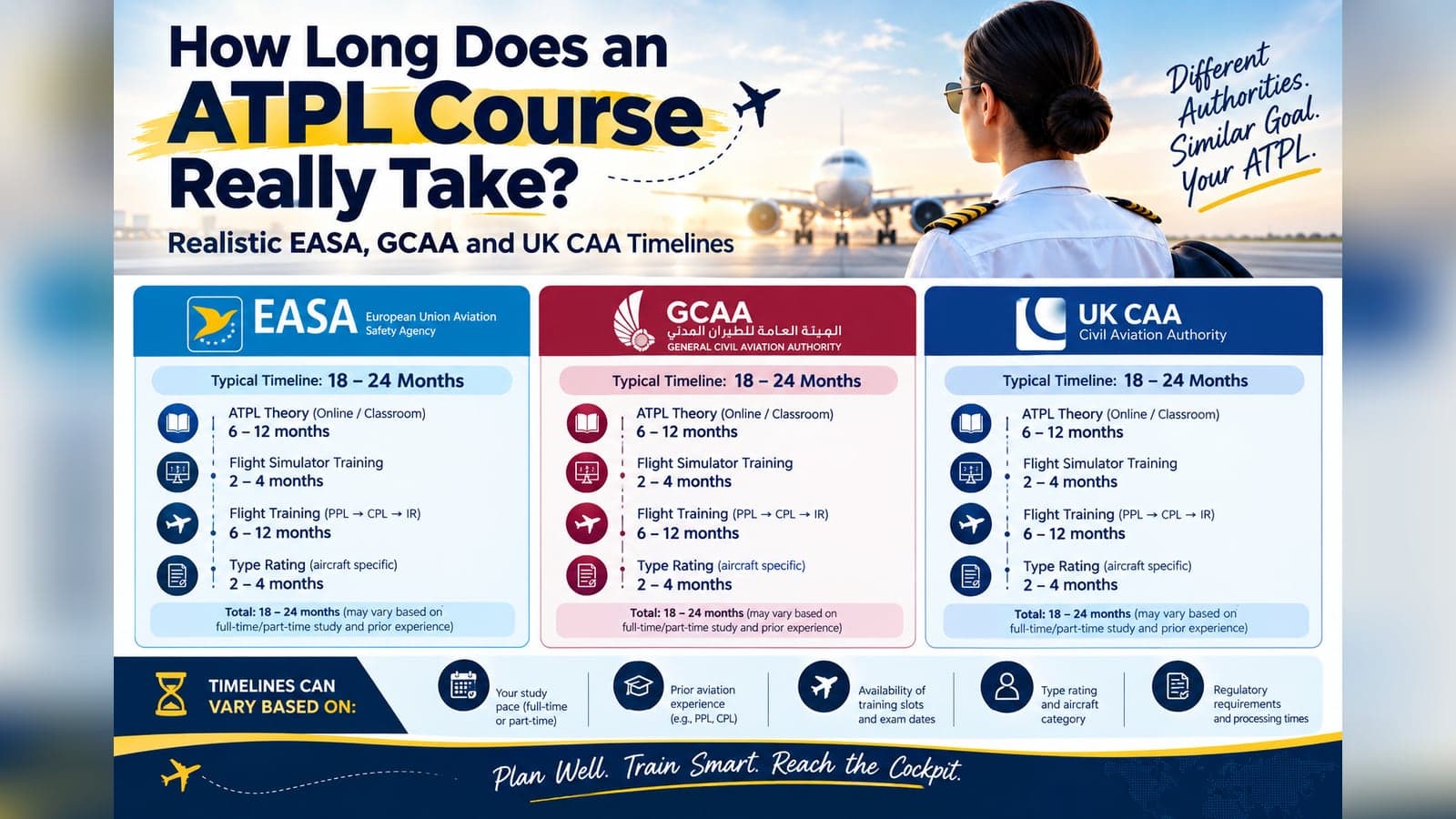
How Long Does an ATPL Course Really Take? Realistic EASA, GCAA and UK CAA Timelines
There is no single timeline that applies to every pilot. What matters most is the way you are being trained.
Capt. Qaddar Sarfraz · 8 August 2026

One of the first questions almost every aspiring airline pilot asks is: “How long will it actually take me to complete my ATPL theory?” The honest answer is that there is no single timeline that applies to every pilot. Your ATPL timeline depends on your licensing authority, whether you are following an integrated or modular pathway, your previous qualifications, the number of subjects you are taking, your available study time, your examination schedule, and—perhaps most importantly—the way you are being trained.
For students pursuing EASA, GCAA or UK CAA qualifications, the regulatory requirements are not identical, and a student studying full-time may progress very differently from someone studying around a full-time job. There is also an important distinction between the time required by a regulatory training course and the time a student personally needs to become exam-ready.
At Airman's Ground, our approach is built around making that learning process structured and efficient. For our subject preparation, we aim to complete each ATPL subject in a maximum of 14 days, where the student's background, availability and progress make that schedule appropriate. That does not mean an entire ATPL qualification can or should be completed in 14 days. It means we structure the intensive preparation of an individual subject into a focused cycle rather than allowing students to spend weeks or months studying without a clear endpoint. And that distinction matters.
What is the short answer?
For a student studying consistently with a structured plan, individual subjects can be prepared intensively over a relatively short period. At Airman's Ground, our target is to complete one subject within a maximum 14-day preparation cycle, followed by question practice, revision and assessment of readiness. The entire ATPL theory programme, however, takes considerably longer because there are multiple subjects, examination requirements and regulatory training requirements.
For example, EASA ATPL(A) includes subjects such as Air Law, Aircraft General Knowledge, Mass and Balance, Performance, Flight Planning and Monitoring, Human Performance, Meteorology, General Navigation, Radio Navigation, Operational Procedures, Principles of Flight and Communications. So the right question is not simply “Can I finish ATPL quickly?” A better question is: “How quickly can I progress through ATPL theory without compromising understanding, examination readiness and long-term competence?”
Does EASA have a fixed ATPL course duration?
Not in the simple sense students often assume. Under EASA's framework, ATPL training can be completed through integrated or modular routes. EASA's current rules specify the applicable training requirements and theoretical knowledge syllabus rather than suggesting that every student must complete the programme in one identical number of months. For an EASA ATP(A) integrated course, EASA's guidance states that the integrated course should last between 12 and 36 months.
The theoretical knowledge component itself has substantial regulatory requirements. For an ATP(A) integrated course, the theoretical knowledge course comprises at least 750 hours of instruction. For the modular route, the minimum theoretical knowledge instruction varies according to the qualifications already held—for example, 650 hours for a PPL holder and lower amounts for applicants holding additional qualifications such as CPL and/or IR. This is why saying simply “an EASA ATPL takes six months” or “an ATPL takes one year” can be misleading. The student's route through the licensing system matters.
How long does GCAA ATPL training take?
The UAE GCAA framework also has defined training requirements. For a GCAA ATPL(A) modular route, the theoretical knowledge instruction requirement depends on the qualifications already held—the GCAA document specifies, for example, 650 hours for an applicant holding a PPL(A), with reduced requirements for applicants who already hold qualifications such as CPL(A), IR(A), or CPL(A) plus IR(A).
The GCAA regulations also state that an ATP modular course should generally be completed within 18 months, although this can be extended where additional training is provided by the ATO. That is important for students targeting aviation careers in the UAE and wider Middle East. A realistic GCAA study plan should therefore take the regulatory framework seriously while also considering the student's personal circumstances.
What about UK CAA ATPL?
The UK CAA follows its own regulatory framework following the UK's departure from the EU aviation regulatory system. Students preparing for a UK CAA ATPL need to complete the appropriate theoretical knowledge examinations and satisfy the applicable licensing requirements. The UK CAA identifies the ATPL theoretical knowledge areas, including Air Law, Aircraft General Knowledge, Mass and Balance, Performance, Flight Planning and Monitoring, Human Performance, Meteorology, General Navigation, Radio Navigation, Operational Procedures, Principles of Flight and Communications.
The important point is that EASA, UK CAA and GCAA students should not automatically assume that the same timeline, examination process or course structure applies to all three authorities. Your training provider should establish your exact pathway before you start.
Why do some students take years to finish ATPL theory?
This is one of the most interesting questions. If an individual subject can be prepared intensively in a structured programme, why do some students remain stuck in ATPL theory for years? Usually, it is not because the syllabus is impossible—it is because the learning process becomes fragmented. A student may:
- Start reading a textbook, then move to another book.
- Download another set of notes and join a question bank.
- Watch YouTube videos and ask questions in online forums.
- Change instructors, take a break, and start again.
- Repeat the same questions without understanding them.
Six months later, the student may have accumulated enormous amounts of material but still not feel ready for the examination.
More material does not automatically produce more knowledge.
Why we use a 14-day maximum subject cycle at Airman's Ground
At Airman's Ground, we believe every subject should have a clear beginning, learning phase, practice phase and readiness point. Our objective is to prepare an individual subject within a maximum 14-day cycle, subject to the student's availability, prior knowledge and demonstrated progress. A typical intensive cycle can look like this:
Days 1–3: build the foundation
The instructor introduces the major concepts and establishes the framework of the subject. The objective is not to make the student memorise hundreds of pages—it is to answer: what is this subject actually trying to teach me?
Days 4–7: develop understanding
The student works through the important concepts with the instructor. This is where difficult areas are identified. Instead of allowing confusion to accumulate, the instructor can immediately address misconceptions.
Days 8–10: apply the knowledge
The student begins applying the knowledge through exercises and examination-style questions. This is where theory starts becoming usable knowledge. The instructor can identify whether a student genuinely understands a concept or has simply memorised a familiar question pattern.
Days 11–12: identify weaknesses
The focus moves toward incorrect answers, difficult concepts, calculation errors, misunderstood terminology and repeated mistakes. This stage is critical: a student who gets 85% of questions correct may still have serious weaknesses if the remaining 15% involve fundamental concepts.
Days 13–14: consolidate and assess
The final stage focuses on revision, targeted practice and assessment. The objective is to determine whether the student is genuinely ready to progress—not “have we finished reading the book?” That difference is fundamental.
Does completing a subject in 14 days mean you only study for 14 days?
No—and this is an important distinction. A 14-day subject cycle is a structured preparation framework, not a claim that aviation knowledge can be permanently mastered in two weeks. Students still need revision, question practice, retention work, examination preparation, instructor feedback and repetition of difficult concepts. The purpose of the 14-day structure is to prevent the student from drifting through a subject indefinitely. It creates momentum, it creates accountability, and it gives the student a measurable target.
Is a fast ATPL course better?
Not necessarily. Fast is only useful when it is effective. A student who rushes through 13 subjects and remembers very little has not gained an advantage. Conversely, a student who spends three months reading one subject without identifying their weaknesses is not necessarily learning more deeply. The objective should be efficient learning, not rushed learning. That is why Airman's Ground combines structured timelines with one-to-one instructor interaction: the instructor can slow down when a student needs more explanation and accelerate when the student demonstrates genuine understanding.
Why expert mentoring can reduce wasted study time
Consider two students preparing for the same examination. Student A reads 300 pages, completes 1,500 questions, gets stuck on a concept, searches online, reads another explanation, continues—and repeats the same mistake. Student B studies the same concept with an instructor, asks questions, receives an explanation, applies the concept, makes a mistake, gets immediate feedback, corrects it and continues.
Both students have access to books. Both have access to question banks. But they are not receiving the same educational experience. The difference is mentorship. A book gives information. A question bank gives practice. An expert instructor provides interpretation, feedback and direction.
Can online ATPL training be faster?
Yes, if the online programme is genuinely interactive. There is a major difference between online content delivery and online instructor-led training. A library of recorded videos may be convenient, but it places much of the responsibility for diagnosing learning problems on the student. One-to-one online instruction is different: the instructor can immediately ask, “Why did you select that answer?” That question can reveal whether the student understands the concept or simply recognised the wording. For aspiring airline pilots, that distinction matters enormously.
What is the best ATPL timeline for a full-time student?
A full-time student can generally dedicate considerably more time to training than someone working 40–50 hours per week. A structured programme might therefore move rapidly through subjects while maintaining revision and examination preparation. But the timeline should be based on:
- Regulatory requirements and the number of subjects
- Student background and available study hours
- Instructor availability and examination scheduling
- Student performance, retention and revision requirements
There is no professional advantage in creating an artificial deadline that compromises understanding.
What is the best ATPL timeline for someone working full-time?
This is where online mentoring can be particularly valuable. A working professional might study:
- 1–2 hours on weekdays
- Longer sessions at weekends
- Scheduled one-to-one instructor sessions
- Regular question-bank practice
- Weekly progress reviews
The important thing is not to copy the timetable of a full-time student. Build the programme around your actual life. A realistic eight-month plan followed consistently is far better than a three-month plan that collapses after two weeks.
Does Airman's Ground teach EASA, GCAA and UK CAA students?
Yes. Airman's Ground provides online preparation for students following different aviation regulatory pathways, including EASA, GCAA and UK CAA theory preparation. However, the regulatory requirements of each authority must remain distinct. The syllabus, examination authority, eligibility requirements and administrative process should always be confirmed against the applicable regulator and the student's individual licensing pathway. Our role is to make the learning process structured and personalized rather than asking students to navigate the entire syllabus alone.
What makes Airman's Ground's approach different?
Don't make students study more. Help them study better.
We do not believe that the best ATPL preparation is measured by the number of books a student owns. It is measured by what the student can understand, explain and apply. Our one-to-one approach allows instructors to work directly on the individual student's weaknesses. Instead of book → notes → question bank → exam, we aim for concept → explanation → application → feedback → practice → assessment. That is a fundamentally different learning cycle.
Can you really finish ATPL faster with expert guidance?
You can make the learning process more efficient. But no reputable training provider should promise that every student will complete ATPL theory in exactly the same number of days. A student's background matters: someone with strong mathematics and physics knowledge may progress differently from someone returning to education after many years, someone with extensive aviation experience may progress differently from a new student, and someone studying eight hours a day will have a different timeline from someone working full-time. That is why our 14-day subject target is a structured preparation framework, not a one-size-fits-all guarantee.
What should students focus on: speed or understanding?
Understanding first. Speed second. The ultimate purpose of ATPL theory is not simply to pass an examination. EASA describes theoretical knowledge instruction as preparing students to become competent commercial pilots capable of applying relevant knowledge to scenarios encountered during professional flying.
You are not studying Performance merely to answer Performance questions—you are learning Performance because future operational decisions depend on understanding aircraft performance. You are not studying Meteorology merely to pass an examination—you are developing the knowledge required to interpret weather and make safe operational decisions. And you are not studying Human Performance because it happens to be another ATPL subject—you are learning how human capabilities and limitations affect aviation operations. The examination is an important milestone. It is not the entire purpose of the education.
So, how long does an ATPL course really take?
The most accurate answer is: it depends on the pathway, regulator, student and training structure. For EASA, GCAA and UK CAA students, regulatory requirements and course structures differ. An integrated programme follows a different timeline from modular training. A full-time student follows a different schedule from a working professional. And a student studying alone follows a very different learning journey from a student receiving continuous expert mentoring.
At Airman's Ground, we break the journey into manageable, measurable stages. Our target is to prepare each individual subject within a maximum 14-day cycle, where appropriate to the student's circumstances and progress. The goal is not to rush students through aviation. The goal is to remove unnecessary wasted time.
Final answer: is a faster ATPL journey possible?
Yes—but efficient does not mean rushed. A well-designed ATPL programme should give students:
- A clear study plan and a defined timeline
- Expert instruction and individual feedback
- Structured question practice and continuous assessment
- Revision opportunities and accountability
Books and notes remain important. Question banks remain important. But without an experienced mentor, students can spend enormous amounts of time trying to determine what matters, what they have misunderstood and what they should study next. That is where expert guidance changes the equation.
At Airman's Ground, our philosophy is to make every study hour count. Rather than allowing a student to spend weeks wondering whether they are progressing, we create focused subject cycles—with a maximum 14-day target for each subject preparation phase—and use instructor feedback and assessment to determine whether the student is actually ready to move forward. Because becoming an airline pilot should not be about spending the most hours surrounded by books. It should be about becoming competent enough to use what those books are trying to teach you.
Frequently asked questions
How long does EASA ATPL theory take?
The timeline depends on the training route, student background, available study time and examination schedule. EASA integrated and modular routes have different regulatory requirements.
How long does GCAA ATPL theory take?
The GCAA framework specifies theoretical knowledge requirements based on existing qualifications, and its ATP modular course is generally expected to be completed within 18 months, subject to applicable extensions.
How long does UK CAA ATPL theory take?
The timeline depends on the student's training route and circumstances. UK CAA ATPL applicants must meet the applicable theoretical knowledge and licensing requirements.
Can an ATPL subject really be completed in 14 days?
Airman's Ground uses a maximum 14-day target for the focused preparation of an individual subject, where appropriate. This is a preparation framework, not a guarantee that every student will achieve mastery or examination readiness in exactly 14 days.
Is it better to study ATPL quickly?
Not necessarily. The objective should be efficient, structured learning that produces genuine understanding and examination readiness—not simply completing pages or question-bank questions quickly.
Are books enough for ATPL preparation?
Books are essential resources, but expert mentoring can help students interpret difficult concepts, identify weaknesses, correct misconceptions and use study materials more effectively.
Can I study EASA, GCAA or UK CAA ATPL online?
Online theoretical knowledge preparation can be available for students following these pathways, but students should ensure their chosen training provider and course meet the requirements applicable to their specific licensing authority and route.
Why does Airman's Ground use one-to-one training?
One-to-one training allows the instructor to adapt explanations, pace and practice to the individual student's strengths and weaknesses rather than treating every student as if they learn in exactly the same way.
The Airman's Ground approach
Learn faster. Understand deeper. Prepare smarter. ATPL theory does not have to become an endless cycle of books, notes and question banks. With the right structure and an experienced mentor, the journey can become focused, measurable and significantly more efficient. Airman's Ground provides personalized online ATPL preparation for aspiring pilots pursuing EASA, GCAA and UK CAA pathways—with a clear focus on expert mentoring, structured learning and competency rather than memorization.