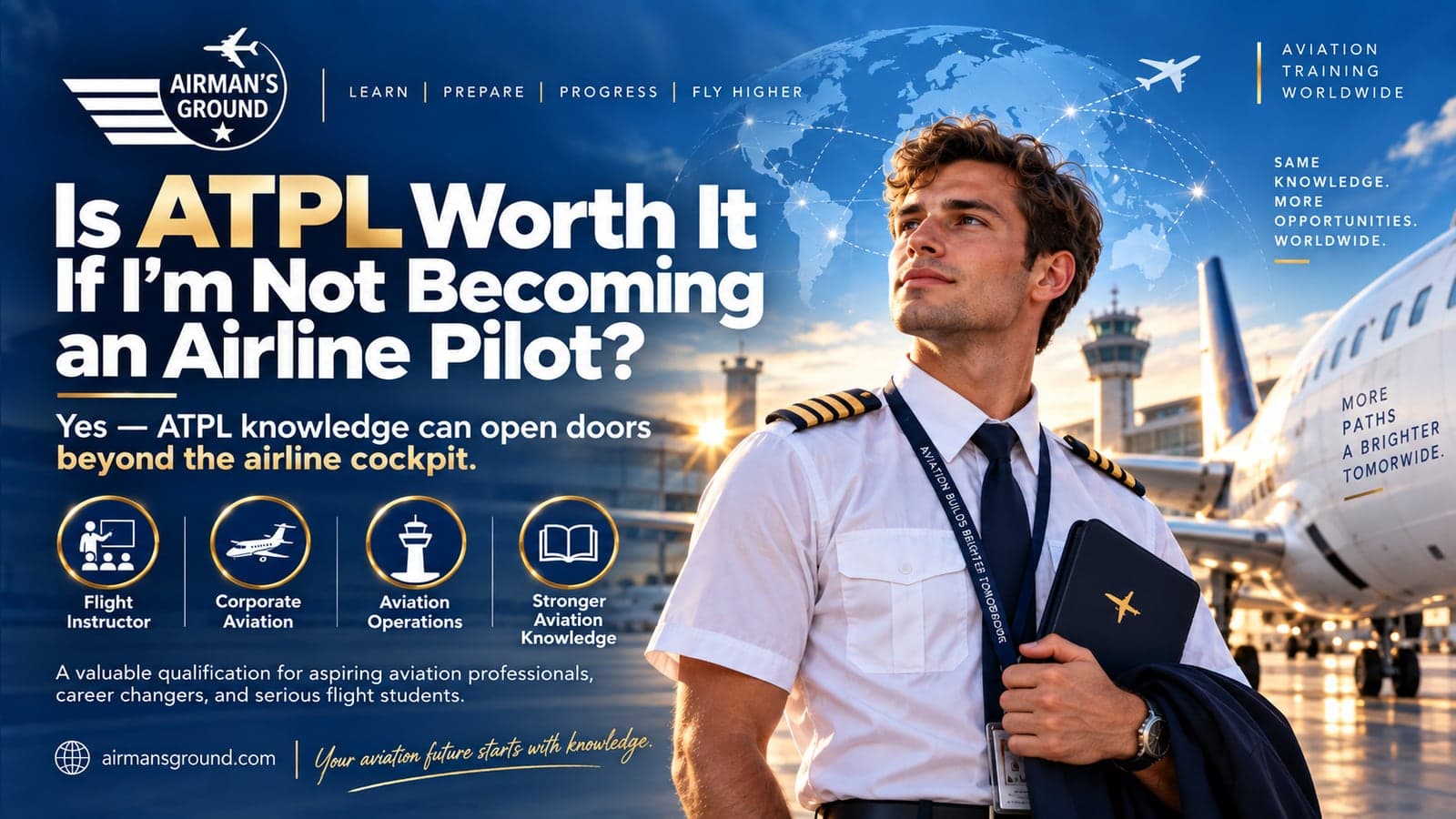
Is ATPL Worth It If I'm Not Becoming an Airline Pilot?
Airline flying is only one part of professional aviation. The better question is what career you are building — and what training supports it.
Capt. Qaddar Sarfraz · 5 September 2026

What is an ATPL?
An Airline Transport Pilot Licence (ATPL) represents an advanced level of professional pilot qualification. It is associated with the knowledge, experience, decision-making and operational standards expected of pilots operating in complex commercial aviation environments.
But there is an important distinction: studying ATPL theory and holding an ATPL are not necessarily the same thing. You may study advanced pilot theory because it supports your professional development, even if becoming an airline captain is not your ultimate career objective.
Do you need an ATPL to become a pilot?
Not every pilot career requires an ATPL. The licence or qualification you need depends on the type of flying you intend to do, the aircraft you operate, the operation you work in and the applicable aviation authority requirements. For some pilots, a PPL or CPL may be more appropriate. For others, advanced ATPL-level knowledge can provide a valuable foundation for professional aviation.
The right question is not simply, “Should I get an ATPL?” A better question is: “What aviation career am I building, and what level of training supports that career?”
Why study ATPL theory if you do not want an airline career?
ATPL-level theory goes beyond memorising examination questions. It introduces pilots to advanced subjects and operational concepts that can strengthen their understanding of aviation. Depending on your career path, this knowledge can support:
- More structured decision-making.
- Better understanding of aircraft and flight operations.
- Stronger knowledge of meteorology, navigation and performance.
- Greater awareness of operational risk.
- Human factors and crew resource management.
- Professional communication.
- A broader understanding of commercial aviation.
For someone serious about aviation, these capabilities can remain useful even when an airline cockpit is not the destination.
Professional pilot careers outside airlines
Airline flying is only one part of the professional aviation industry. Pilots may build careers in areas such as:
- Corporate and business aviation.
- Charter operations.
- Air ambulance and specialised operations.
- Flight instruction.
- Ferry and delivery flying.
- Aviation training.
- Flight operations and safety.
- Other commercial or specialised aviation environments.
The exact licence and experience requirements vary by operation and regulator, so career planning should begin with the role you want rather than with a qualification chosen in isolation.
Corporate and business aviation
Corporate aviation can offer a very different operating environment from scheduled airline flying. Business aviation pilots may operate smaller or mid-size aircraft, work with private companies or individuals, and encounter varied destinations and operational conditions. Advanced theoretical knowledge can help pilots understand the wider operational environment, particularly as responsibilities increase and operations become more complex.
Charter and commercial aviation
Charter operations can involve varied routes, passengers, aircraft and operational requirements. For pilots considering commercial flying outside the traditional airline model, strong theoretical preparation can support progression and professional development. However, the specific licence requirements depend on the operation, aircraft category and relevant authority.
Flight instruction
Some pilots eventually discover that they enjoy developing other pilots as much as they enjoy flying themselves. Flight instruction can become a long-term aviation career or an important stage of professional development.
An instructor needs more than flying skill. The ability to explain concepts, identify learning gaps, communicate clearly and manage human factors is equally important. Advanced theoretical knowledge can strengthen the instructor's ability to connect practical flying with the underlying principles.
Aviation safety and human factors
Aviation is not only about aircraft handling. Modern aviation places significant emphasis on human performance, communication, situational awareness, threat and error management, decision-making and organisational factors. For pilots interested in safety, training or operational roles, advanced aviation knowledge can provide a stronger foundation for understanding how technical and human factors interact.
Aviation training and education
A pilot who develops strong technical knowledge may eventually move into aviation education, ground training, standardisation or instructional development. This can include:
- Ground instruction.
- Pilot mentoring.
- Training content development.
- Human factors education.
- Examination preparation.
- Competency-based training.
- Pilot development programmes.
For these paths, understanding why aviation concepts work can be more valuable than simply remembering the correct examination answer.
Aviation management and operations
Not everyone who studies aviation ultimately spends their entire career in the cockpit. Some aviation professionals move toward flight operations, safety management, training management, aviation business, airline or airport operations, regulatory and compliance functions, or aviation consultancy. A strong technical foundation can help professionals communicate more effectively with pilots, instructors, engineers, operations teams and management.
What about private pilots?
A private pilot may also choose to study advanced aviation subjects simply because they want a deeper understanding of flying. You do not need to turn every qualification into a career. For an aviation enthusiast, advanced theory can be a way to become a more knowledgeable and disciplined aviator. The important consideration is whether the additional training matches your goals, available time and budget.
ATPL theory vs. holding a full ATPL
This distinction is often overlooked. Studying ATPL theory does not automatically mean that you are pursuing a full ATPL licence at that moment. Theory preparation may be one component of a wider professional pilot pathway. The complete licensing pathway can involve additional requirements such as flight experience, skill tests, medical requirements and other regulatory conditions.
That means ATPL-level theory can have value even when your immediate goal is not to become an airline captain.
Can you study ATPL theory online?
For students who need flexibility, online ATPL theory can make advanced aviation education considerably more accessible. A well-designed online programme can allow students to study from their home country while completing theory and examination preparation before progressing to flight training. This can be particularly useful for students in the Middle East and GCC who may plan to complete flight training in Europe, the UK or the UAE.
The key is not simply whether the course is online. The quality of instruction matters. Books, notes and question banks provide information. They do not replace an expert mentor who can explain a difficult concept, identify a student's weakness and connect theory to real operational situations.
Why expert mentorship still matters
Aviation theory is interconnected. A student may be able to memorise a question-bank answer without fully understanding the principle behind it. That becomes a problem when the same concept appears in a different context. Expert-led training helps students move from “Which answer is correct?” to “Why is this the correct answer, and what would happen if the situation changed?” That shift from memorisation to understanding is especially important for competency-based pilot development.
Where Airman's Ground fits in
Airman's Ground approaches aviation theory as part of broader pilot development rather than as examination preparation alone. Its model focuses on expert-led online instruction, personalised learning, discussion of real aviation scenarios and identification of individual learning gaps.
Students can prepare for aviation theory and examinations while developing a stronger understanding of the subjects behind the questions. The objective is not simply to finish a syllabus — it is to help the learner become more prepared for the next stage of aviation training. For students pursuing EASA, GCAA or UK CAA pathways, online theory preparation can also provide flexibility while flight training is completed separately through the appropriate flight training organisation.
Is ATPL training financially worth it?
The answer depends on what you intend to do with the knowledge. A qualification becomes financially meaningful when it supports a realistic career or development plan. For some students, ATPL preparation may be part of a professional pilot pathway. For others, it may support instruction, aviation training, safety, operations or future career progression.
Online theory can also reduce certain indirect costs associated with relocating solely for classroom-based theory training, such as travel, accommodation and time away from work or family. The financial benefit depends on the student's individual circumstances, training pathway and regulatory requirements.
When ATPL may not be necessary
ATPL training may not be the most appropriate investment if:
- You only want recreational flying.
- Your intended licence does not require ATPL-level theory.
- You have no professional aviation objective.
- The additional subjects do not support your planned role.
- The training would create financial or time pressure without a clear benefit.
More training is not automatically better training. The goal should be relevant training.
When ATPL training can make sense without an airline goal
ATPL-level study may make sense when you:
- Want a professional aviation career outside airlines.
- Plan to become a flight instructor.
- Want deeper technical knowledge.
- Are interested in aviation safety or human factors.
- Want to work in aviation training.
- Are building an aviation business.
- Want to understand commercial aviation operations.
- Expect your career direction to evolve later.
The decision should be based on the competencies and opportunities you want to build.
ATPL is a pathway — not a career plan
One of the most useful ways to think about ATPL training is to work backwards. Start with the destination — what role do I want? Then ask: what licence do I need, what experience do I need, what knowledge do I need, and what training provider and pathway fit my circumstances?
This prevents students from collecting qualifications simply because they are considered prestigious. The strongest aviation training plan is the one that connects learning directly to a future role.
The future of aviation needs more than flying skills
Aviation is evolving rapidly. Pilots and aviation professionals increasingly need to understand automation, artificial intelligence, human performance, safety, communication and complex decision-making. The future pilot will not be defined only by the ability to control an aircraft.
Professionalism, adaptability, communication, situational awareness and sound judgement will remain important parts of aviation competence. That is why a strong aviation education should develop the person behind the licence, not only prepare them for an examination.
Frequently asked questions
Is ATPL worth it if I don't want to become an airline pilot?
It can be, depending on your aviation career objective. ATPL-level knowledge may support professional flying, instruction, safety, training, operations and other aviation pathways.
Can I study ATPL theory without immediately becoming an airline pilot?
Yes. Theory preparation can be completed as part of a broader aviation development plan, subject to the requirements of the relevant authority and pathway.
Can I study ATPL theory online?
Online theory preparation can provide flexibility, particularly for students who intend to complete flight training in another country. The quality and structure of the training are important.
Is ATPL theory useful for flight instructors?
Advanced theoretical knowledge can help instructors explain aviation concepts and connect practical flying with underlying principles, although instructor licensing requirements vary.
Do I need an ATPL for every professional pilot career?
No. Requirements vary according to the role, operation, aircraft and regulator.
Is ATPL theory just about passing exams?
It should not be. Question banks are useful examination tools, but understanding the principles behind the answers is important for professional development.
Final thought
You do not have to become an airline pilot for advanced aviation education to have value. The better question is whether the knowledge supports the aviation professional you want to become. If your goal is corporate aviation, charter, instruction, safety, training, aviation management or simply becoming a more knowledgeable pilot, ATPL-level study may form part of that journey.
Choose the qualification according to the career. Choose the training according to the learning. And choose a pathway that develops competence — not just certificates.